This property is located in the Corazon de Jesus neighborhood of Puerto Armuelles.
Hi, this is Betsy Czark from Living in Panama.
And this is a glimpse of the beach that's in front of this property we have for sale.
This gorgeous property is big:
- 11,000 sq. feet
- Only 70 yards from the beach
- Located in Puerto armuelles,
To get to the charming beach town of Puerto Armuelles,
- Take a short flight from Panama City to David, which is in the Chiriqui Province.
- Then drive an hour and 15 minutes to historic Puerto Armuelles.
What you see here is Puerto Armuelles’ downtown waterfront park.
Puerto was built by Chiquita Banana starting in the 1920s.
Chiquita built a town with a charming look and feel and one that looks different from most other towns in Panama.
Puerto is also unique in that it is one of the only ocean-front towns in Panama.
Up ahead you can see a row of restaurants and bars facing the waterfront park, as well as a statue of the town’s namesake, Colonel Armuelles
On the left, you can catch a glimpse of it’s popular “town square” park, plus a new playground.
Right now, let’s go to 11,000 sq foot property we have for sale.
This beautiful property is only 10 minutes from downtown Puerto Armuelles.
We are almost at the property now. All the beachfront homes, which are to your right on this street are owned by expats.
The property is in a great location.
Not only is it close to downtown, but there are restaurants, grocery store, and a hardware store even closer - 5 minutes away.
This beach neighborhood is a mixture of locals and expats.
The cement building on the corner has now been remodeled to be a garage for the expat who owns the beachfront house across the street.
This is the ample 16 foot wide access road to the property.
Welcome to the property!
This sizable property is both beautiful and quite affordable.As you can see, since I am easily driving on it, this property is flat and ready for your home construction.
Actually, this property could fit 2 or 3 houses on it.
The property is serviced by city electricity and water.
Currently, this neighborhood is not on the city sewer, but our new mayor has vowed to change that. In the meantime, like many beach communities, septic tanks are used.
And as I mentioned, this property is quite affordable.
This 11,000 sq foot property is only $40,500. Plus we offer easy financing.
As we exit the property, you will see how close the beach is.
You can easily stroll on the beach, swim, stand up paddle board, or surf from your property.
It is a wonderful place to live.
I leave you with some views of the beach.
For more information or to tour the property, contact me at LivinginPanama.com by clicking the link.
Living in Panama: The place for information & advice on being an expat in Panama.
Interested? Click "subscribe" and hit the bell so you so you don't miss a video.
Thanks for watching!
Just a few days ago, there was another beach clean up in our town of Puerto Armuelles.
As I was writing about Puerto's beach clean up, I thought I should say something about trash in Panama. Panama's litter and lack of garbage service is an obvious and unsightly issue. I intended to write a paragraph or so about it.
I have always considered myself as someone who cares about the environment, certainly not a fanatic, but it is something I consider. I try to use reusable water bottles, cut up those plastic bands that hold 6-packs of soda together, bike instead of drive sometimes, and such actions. Basically, I am an environmentalist when it is convenient to be an environmentalist.
However, my research for that paragraph has opened my eyes and radically strengthened my commitment to the environment. The short paragraph or so I had planned on writing has expanded to this longish article you are reading now.
Puerto's beach cleanup, while commendable, is simply an aside to the bigger issue of trash, particularly plastic trash, in Panama and around the world.
Maybe the information in this article will open your eyes more fully as well.
It can be dismaying for North Americans & Europeans to see all the litter and piles of garbage in Panama and in Central America overall.
One reason you see so much trash here is that the composition of trash has changed. The popularity of processed foods with its non-biodegradable packaging, styrofoam dishware, and the now-ubiquitous plastic bags and bottles have changed the character of litter and garbage.
In North America, this change happened many years before its impact was fully felt in Central America. Panama has not had the time nor education to change their traditional garbage disposal habits.
Back in the day, dumping your trash in a pile, into the ocean or burning it did not have all the negative impacts it has today. Not that long ago, all or almost all the trash was bio-degradable.
Now a big percentage of the garbage consists of plastic bags, styrofoam dishware, and other non-biodegradable packaging and items of all kinds. For instance, styrofoam dishware and building products like M2 have a lifespan of about 500 to 1,000 years. And such products are increasingly popular.
Check out our article about building your house with M2. It includes a discussion of M2's impact on the environment.
Fish and animals are eating our discarded plastics and other toxic substances. The trash is no longer being composted to be part of the earth once more. This problem is huge. Not just for Panama, but for the planet and its animals.
Later on in this article, I discuss ways that the Panamanian government is trying to solve this problem by endorsing zero waste and clean sea initiatives, banning plastic bags, and more.
One of the reasons for the abundance of litter in Panama is the lack of garbage cans in public spaces. If there are no garbage cans and no community-consensus that littering is unacceptable, what happens to empty juice boxes and wrappers? They are dropped on the ground of course.
And even when a city provides garbage cans they are often not emptied on a regular basis. Failure to empty over-flowing garbage cans indicates to the public that the government does not think that piles of garbage are an issue. It encourages an "if the city cannot be bothered to pick up the trash, why should I" mentality.
Garbage pick up from homes is also an issue. Many people don't want to or cannot pay the $4 - $6/month for garbage pick up. And in some areas, especially more rural areas, garbage service is not available.
Lack of adequate garbage service and public health education results in many people in less dense neighborhoods burning their trash. Other people throw it in ravines, into rivers, or another out-of-the-way spot.
A lot of that garbage makes its way into rivers and then on to beaches and then into the ocean.
According to Panama's Urban and Domiciliary Cleaning Authority (AAUD), the country produces more than 4000 tons of waste, out of which some 480 tons find its way into the Bay of Panama. And the Bay of Panama is only one part of Panama's ocean.
Efforts to combat litter and clean the environment are growing. And growing rapidly. Over the last 2 years alone, many more initiatives, pilot programs, and more are being pursued by both community groups and the government.
In January 2018, Panama became the first Central American country to ban the use of plastic bags.
This means that starting July 20, 2019, your groceries will no longer be bagged using plastic in Panama.
Supermarkets, pharmacies and retailers in Panama must stop using traditional polyethene plastic bags by July 20, 2019. Larger and wholesale stores will have 6 more months, until February 20, 2020, to stop using single-use plastic bags.
Starting on July 20th, shop owners are required to replace plastic bags with more environmentally friendly options like containers made of non-polluting materials or reusable plastic. They can sell their customers these reusable bags or containers at cost.
There is an exception. Article 3 of this Law also establishes an exception: "it is not applicable when polyethylene bags must be used to contain processed or pre-prepared foods or wet items and it is not feasible the use of a substitute compatible with the minimization of the environmental impact".
The goal of the law is to reduce plastic consumption by 20% across Panama. Any fines imposed for non-compliance will be used to support recycling programs.
UPDATE: post-July 20th, read how Panama's plastic ban is a success.
About Plastic Bags. In the early 1960s, the "T-shirt" plastic bag which supermarkets use was invented by a Swedish engineer, Sten Gustaf Thulin. By the mid-1980s these single-use grocery bags were used extensively in Europe and in North America. In 1997, Charles Moore discovered the Great Pacific Garbage Patch in the Pacific Ocean. It is a huge floating island mostly made up of discarded plastic bags and other plastic items.
Plastic bags come from the same source as all plastic: crude oil. It takes approximately 400 years for just 1 plastic bag to decompose. And that plastic bag, on average, is used to carry things for only 12 minutes. It is mind-boggling when you start to think about it. To find out more about the history of the plastic bag, click here.
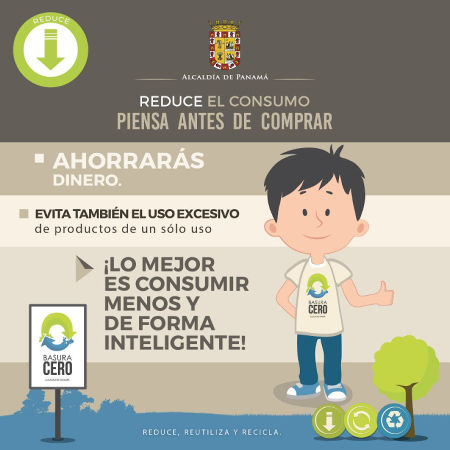
On May 30, 2018, Panama further committed to a clean environment by passing its Zero Waste (Cero Basura) Policy.
What does zero waste mean? Every jurisdiction seems to have a slightly different take on it.
In general, zero waste is a new approach and philosophy to how we think of garbage, of product design, of packaging and more. One way to describe it is that a zero waste policy seeks to maximize recycling, minimize waste, reduce consumption and ensure that products are designed and made to be reused, repaired or recycled back into nature or the marketplace.
Less consumption, bio-degradable packaging, recycling and composting are 4 of the most obvious ways to get closer to zero waste.
The County of Hawaii's approach (below in italics) on zero waste may be a philosophy that Panama's indigenous population would appreciate. I know the Kuna people of Panama have embraced a similar approach.
"Zero Waste" is a way of life that promotes the goal of reducing the amount of material we throw away and instead reincorporating by-products of one system for use for another system. There is no such thing as "waste" in Nature. In nature, the by-product of one system is feedstock for another system. Only humans have created this thing like "waste." Ancient Hawaiian culture lived this way before the term "Zero Waste" came to be. We can live this way again through small shifts in our daily activities. In this way, we greatly reduce our impact on Hawai'i Island's natural environment, and how much rubbish we generate, protect Hawai'i Island's natural environment, preserve our resources for future generations, and save our community tax dollars.
Zero Waste is a global trend. More cities and countries are committing to zero waste as it is becoming increasingly clear that it is the only way to deal with the world's looming garbage crisis.
I am not sure what Panama, as a nation, intends to do in order to accomplish or at least get nearer to zero waste. I have seen flyers, like the one above, that the mayor of Panama City published. On the national level, I cannot find anything except some dense and jargon-filled statements about it. They are so vague as to be meaningless.
However, Panama's zero waste policy is still new and it is a very complex topic. Stating it as a goal is a good first step. Figuring out how to accomplish it will be Panama's challenge in the years to come.
Panama was the first in Latin America and the Caribbean to join the UN Environment's CleanSeas campaign. The campaign's focus is on fighting marine plastic pollution.
The CleanSeas campaign aims to raise awareness of what plastic waste is doing to our oceans, our wildlife and ourselves. To help reduce plastic pollution, the campaign is targeting the production and consumption of non-recoverable and single-use plastic.
As Erik Solheim, UN Environment’s Executive Director states:
“Our aim is to redefine the world’s relationship with plastics because that is the only way to save our seas. Only by fundamentally transforming the way we consume can we secure the oceans that sustain human life. What we need is a revolution.”
Since it launched in February 2017, 60 countries have joined the campaign with many making specific commitments to protect oceans, encourage recycling and cut back on single-use plastics. Those countries cover more than 60 percent of the world’s coastlines.
Panama, a country with almost 3,000 kilometers of coast in the Pacific Ocean and the Caribbean Sea, is pushing for comprehensive reforms that will improve its relationship with oceans. For instance, Panama is currently drawing up a national plan and legislation to combat marine litter.
In fact, 2 deputies very recently introduced Bill 170 to eliminate styrofoam in Panama. The bill proposes to prohibit styrofoam from coastal areas and in public places in general. As of April 17, 2019, it is under consideration by the Commission of Population, Environment, and development.
You may want to check this video (below) that I found on the Clean Seas website (cleanseas.org). It covers plastic's history, impacts, and the complexities in finding a solution to plastic & plastic waste.
All the efforts to raise environmental awareness in Panama seem to be working. At least, there has been a definite upswing of community groups participating in clean-up campaigns over the last 2 or 3 years.
In years past, people would generally get together once a year to clean up the beaches after the rainy season. Now such cleanup efforts are much more frequent.
This last weekend alone, April 6-7, there were a number of cleanups in Panama. The one I mentioned in Puerto Armuelles occurred on April 7th. You can find out more about Puerto's beach cleanup here.
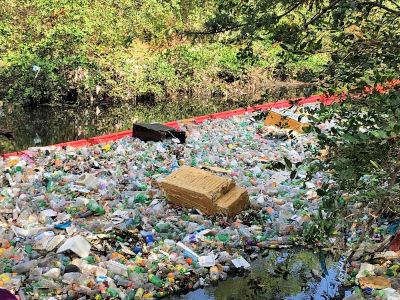
Another successful cleanup event this last weekend happened at Panama's Matias Hernadez river.
The Marea Verde Association is conducting a pilot program called BOB, which stands for Barrera o Basura. (In English, Barrier or Garbage).
BOB is basically a tied together line of large orange floating buoys (see photo). BOB reminds me of the barriers used to make swimming lanes in a pool, but much bigger.
BOB's buoys are stout enough to capture all the garbage floating downstream.
Generally, they install BOB across a river before a big storm in order to stop any garbage flowing down the river. Then they collect that garbage so it does not end up on beaches and in the ocean.
Most recently, they installed BOB on the Matias Hernadez river in anticipation of last Saturday's storm. This "dam" captured an enormous number of plastic bottles and other garbage.
The Marea Verde Association did a fabulous job cleaning up the river. Without their efforts, all that garbage would now be in the Bay of Panama (Bahia de Panama).
In another part of Panama, the students from the International Academy of Boquete spent this last weekend cleaning up the well-known Quetzales trail in the National Forest reserve. In addition, the Marabuntas Chiriqui group organized a community clean up of the river in Dolega on April 7th.
I'm sure there were more cleanup efforts I have not heard about. And I imagine there will be even more activity on Earth Day (April 26th)
Without a doubt, more and more people are organizing to clean up Panama's outdoor spaces. A commendable community service.
There is also a greater awareness of the negative attributes of littering, a greater desire not to see trash littered on the ground. Even looking around our small town of Puerto Armuelles you will see many more "Prohibido Tirar Basura" (no littering) signs than you saw in years past.
As you have read, nationally, there has been a much greater commitment to a garbage-free landscape. And there are signs of it in various cities as well. For instance, I have seen public recycling bins in David's Parque Central (central park).
As the public's environmental awareness increases, there must be some infrastructure changes as well. Small, but critical items that will encourage and positively reinforce the growing desire to keep the planet clean.
One of the best ways to change cultural attitudes about trash is in schools. Panama already has various anti-littering programs in schools. Hopefully, expanding these programs and methods will not only help eliminate litter but also improve our environment worldwide.
Education is not enough. Garbage cans and garbage service are 2 critical items that need to be provided. But for the most part, public garbage cans are few and far between in Panama. There won't be an appreciable change in littering until many more public trash cans are provided. And those cans must be regularly emptied before they start to overflow.
Plus, local garbage service should be expanded. Paying for regular garbage service should be encouraged, if not required. For those that cannot afford it, subsidized or free garbage service should be considered.
Given a choice, most people want the city to haul away their trash. It is much easier than having to haul it to the nearest ravine or another unofficial garbage dump. And it is in the best interest of everyone to provide garbage disposal. Garbage dumped in ravines and elsewhere is almost guaranteed to end up on our beaches and into the ocean.
Of course, there are a number of issues not addressed here. For instance, what to do with the garbage once it is collected? Improperly managed landfills are a hazardous issue in Panama. Google "landfill fires in Panama" to find out more.
And what about recycling? Recycling sounds like an easy solution, but it is actually quite complex and is often too costly to accomplish. Now that China is no longer accepting the world's plastic and various other waste, it has become even more complex and costly.
It seems clear, "What we need is a revolution", as the UN Environmental director said. A revolution in the way we consume. A new philosophy that is closer to the "Leave No Trace" motto that backpackers & campers embrace.
In my opinion, a world-wide zero waste goal is impossible to achieve. However, perhaps we should try to get as close as we can.
For that reason, I was really pleased to learn that Panama has eagerly signed on to a number of worldwide and local initiatives to lessen's Panama's negative environmental impact.
We are still in the early days of the fight for the planet's health. I am happy that Panama is one of its warriors.
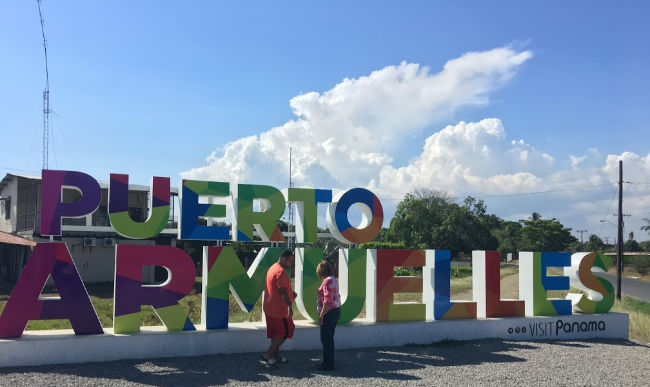
Colorful town signs have been popping up all over Panama.
After much anticipation, Puerto Armuelles has one of its own! (see photo above)
Our beach town is coming up in the world!
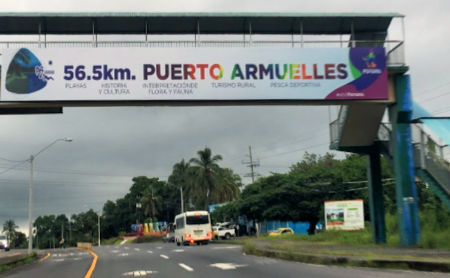
Panama's national tourism agency, Visit Panama, is promoting Puerto elsewhere too.
I was able to photograph its banner promoting Puerto Armuelles (see photo).
The banner was hanging on an overpass outside of David, on the way to Puerto Armuelles.
It is not at the roundabout.
Many people assumed that the Puerto Armuelles sign would be installed on our new roundabout.
The roundabout, the only one in Puerto, is near the entrance to town. It was installed as one of the final parts of the road expansion from a 2 lane to a 4 lane road.
It seemed like this wide round expanse of lawn was custom-made to celebrate our town's sign.
Safety Issues Determined Location
But the design aesthetics of putting it on the roundabout lost out to safety concerns.
Not only would the two-word high sign hamper visibility, but that location would put pedestrians in harm's way.
There is no parking nor sidewalk at that location. People would have to cross the circle road, on foot, to take a photo of themselves by the sign. It is not a busy road, but there is enough traffic to make that potentially dangerous.
In fact, the sign was up for only a few hours and people were already climbing all over it to take town-proud photographs.
We are very much looking forward to taking a group picture by the sign ourselves.
I have been impatiently waiting for Puerto Armuelles to get its own colorful 3-D sign for quite some time now. I am quite happy that we finally have it.
Sign Location
The sign is located on the main road - past the roundabout - as you head into town.
More specifically, it is in the Los Angeles neighborhood, between Restaurante Enrique and ESPA.
There is plenty of space for pedestrians and cars to hang out by the sign. No need to endanger yourself by dashing across the street to take a photo.
Feel free to post your photos of the sign in the comments below.
Here it is:
Foreign buyers are pushing up property prices in Panama. The average dwelling sales price surged by 21% from January 2015 to June 2017 in Panama's metropolitan area, according to the Panamanian Chamber of Construction (Capac) as reported by La Estrella de Panama.
Foreign buyers tend to be from the United States, Europe, Canada, and Latin America.
Yet at US$2,050 per square meter (sq. m.) in June 2017, the average price of residential properties in Panama still looks very reasonable, with metropolitan prices ranging widely from US$ 928 to US$ 2,892 per sq. m., according to Capac.
In Punta Pacifica, a collection of exclusive waterfront skyscrapers, high-end apartment prices are rising by 6% to 12% per annum, due to a shortage of available units. The average price in Punta Pacifica stood at around US$ 2,300 per sq. m. as end-2017.
Sales and construction were both up in 2017, says Maria Arias of TDI Real Estate. Arraiján and La Chorrera, where property prices start at around US$30,000, are specially active, due to infrastructure developments in Panama West and Panama East's constant growth.
It is a big turnaround. After the global financial crisis in 2008, Panama's dwelling prices declined by an average of 20% to 30%, according to Kent Davis of Panama Equity Real Estate.
Only after 2012 did foreign buyers return to the market.
Now it is the opposite story. Many infrastructure projects are approaching completion, and Panama's economy will continue to accelerate in 2018 and 2019.
Another boost to the market will be the new property tax law to be implemented from January 2019, which gives tax exemption to all primary residences worth more than US$ 120,000 (previously US$30,000), and generally reduces property tax rates.
Read about the new Panama property tax law
Tourist arrivals rose by 7.5% to about 2.5 million people in 2017, says the Panama Tourism Authority, with European visitors up 8.1% (though tourist spending only rose 3.8% to US$ 4.5 billion in 2017).
According to the Panama Tourism Authority, these numbers are expected to rise further since Air China now has direct flights to Panama. This will attract Chinese tourists.
Foreigners can own real properties in Panama, and are accorded with the same property rights as Panamanians. However, mortgages can be difficult to obtain, especially for foreigners, and the purchase process can take two to three months. More than 80% of real estate transactions involving foreign buyers are in cash.
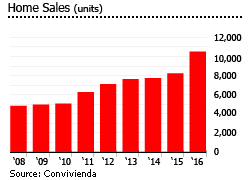 Panama house sales rose 7.7% to 8,864 units in 2016 from a year earlier, according to the National Board of Housing Developers (Convivienda), though transaction values fell by 6.3%. House sales in 2017 reached around 10,958 units, 23.6% up on the previous year, with total value of sales expected to have risen by 23.6%, to PAB 979.65 million (US$ 983.10 million).
Beach apartments are increasingly in demand by both local and foreign buyers. The most popular areas include Punta Chame, Playa Blanca, Farallon, El Palmar (Hato River), Santa Clara, and Rio Mar (San Carlos).
Demand is supported by a stronger mortgage market. "The improvement in conditions for residential mortgages in recent years has been the principal promoter for housing," says the Superintendencia de Bancos de Panamá. Residential mortgages granted rose 10.1% to PAB 14.08 billion (US$ 14.13 billion) in 2017, as low interest rates and higher average terms increased the purchasing power of families. The interest rate on housing loans was 5.5% in December 2017, unchanged from the same period last year.
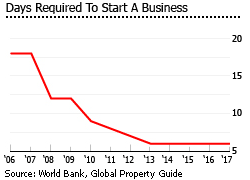
It requires only six days to start a business in Panama, according to the World Bank’s 2017 survey. Panama is the 2nd most competitive country in Latin America and the Caribbean, according to the World Economic Forum's Global Competitiveness Report 2017-2018.
Panama draws multinational companies and foreign investors with significant tax breaks, the free-trade zone, improved infrastructure, and a low cost of living. The expansion of the Panama Canal, which was opened in June 2016, is expected to bring in over US$2 billion in annual revenues by 2021.
“There are so many new businesses moving to Panama,” said Kent Davis of Panama Equity Real Estate. “It’s one of the reasons people are coming down – because there is still money to be made, locally, and as a regional base of operations.”
“People aren’t just moving here to relax,” Davis added. “They’re coming here to work because there is so much business around.”
Panama encourages foreign direct investment (FDI) in real estate by offering various incentives such as property tax exemptions, according to Jeff Barton of Punta Pacifica Realty.
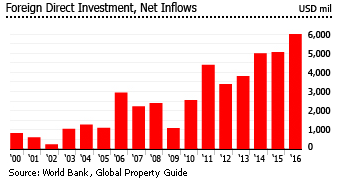
Panama has the highest foreign direct investment (FDI) share of GDP in Latin America, at more than 10% of GDP, according to a United Nations report. Panama is also the largest recipient of FDI in Central America, with 44% of 2016's regional FDI total of US$ 11.97 billion. In 2017, the country's FDI rose by about 1.8% to about US$ 5.319 billion from the previous year, according to the Comptroller General of the Republic of Panama.
"The international community recognizes that Panama is a stable democracy and it is the fastest-growing country in Latin America," said Economy and Finance Minister Dulcidio De La Guardia.
For what it is worth, International Living’s Global Retirement Index names Panama as one of the world’s best places to retire in 2018, due to its convenience (ease of access from US, currency in US dollars, English is widely understood), world-class amenities, good beaches, and affordability.
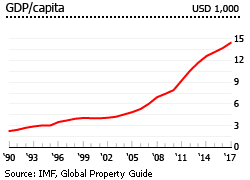 But let's look at the dark side too. Despite economic growth and a GDP per capita of US$14,409 in 2017, poverty and social inequality continue to worsen in Panama. Elite families of European descent control most wealth and power, while about one-third of the population lives below the poverty line.
Panama has been removed from Financial Action Task Force's (FATF) "grey list", but money-laundering is still rampant.
In June 2014, Panama was placed on the "grey list" of Financial Action Task Force (FATF) of countries not doing enough to fight money laundering. FATF officially took Panama off its money laundering and terrorism financing watch list in February 2016, after new government regulations.
Despite this, money laundering and terrorist financing are believed still rampant in Panama. No real controls prevent funds moving through Panama to terrorist organizations, nor are do money laundering prosecutions actually take place. Moreover, Panama's powerful criminal syndicates remain fully operational.
In a recent report by the Latin America Financial Action Task Force (Grupo de Acción Financiera de Latinoamérica – GAFILAT), GAFILAT noted that the government's anti-laundering efforts are good, signalling progress in fighting money laundering. However, the report also pointed some deficiencies that the government must work on.
According to the GAFILAT report, the country was observed to be more susceptible to illicit streams of revenue from foreign sources than domestic ones. The GAFILAT enumerated the sectors of real estate, banking and corporate services, and free trade zones as the most vulnerable sectors to money laundering.
The task force also identified almost 730,000 businesses in the country that are considered at "high risk" of partaking in money laundering, during its investigation in May 2017.
Panama City is divided into two main areas – the old colonial town of Casco Viejo, and the modern business and shopping district of high-rise buildings and malls.
 House prices vary considerably depending on the location, size, and quality of the property.
Panama's gross rental yields are still good, despite having declined over the past few years. Rental yields are range from 5.7% to 7.3%, with smaller apartments tending to yield more, based on the Global Property Guide research in November 2016.
Most properties in Panama City are apartments.
Based on the figures from Encuentra24, 2016 apartment prices in Panama City were:
Inland apartments ― ranging from US$ 1,900 per sq. m. to almost US$ 2,500 per sq. m.
Beachfront apartments ― ranging from US$ 1,800 per sq. m. to US$ 3,600 per sq. m.
Boquete, in Panama’s mountain highlands, has a fast growing expatriate community. The popular option here is to buy land and build a home, but there are many completed homes on offer.
Sample property prices for Boquete are as follows:
2-bedroom, 1-bathroom home, about 1,600 sq. ft. – US$90,000
3-bedroom, 2-bathroom home, about 1,500 sq. ft.– US$179,000
Another desirable location is Coronado, a popular beach town and relaxed community for expats, and only an hour from Panama City.
Sample property prices for Coronado are as follows:
3-bedroom, 2-bathroom home, about 1,300 sq. ft. – US$132,000
2-bedroom, 1-bathroom furnished condo, about 850 sq. ft. – US$135,000
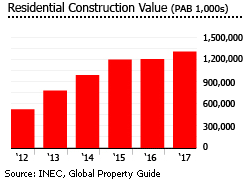 Panama is now in a state of permanent construction boom.
In 2017, the value of residential construction rose by 12.2% to PAB 1.29 billion (US$ 1.29 billion) from the previous year, when it rose by 0.6%m, after annual increases of 21.1% in 2015, 26.8% in 2014, and 48.8% in 2013, according to the Instituto National de Estadistica y Censo (INEC), all of which follows a decade of breakneck building which raised occupied housing units by 31.5% between 2000 and 2010, according to the National Censuses.
Total credits granted to the construction sector rose by 8.2% In 2017 to around PAB 6.74 billion (US$ 6.77 billion), according to Superintendencia de Bancos de Panamá.
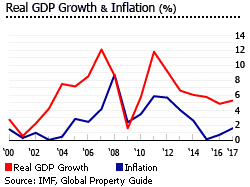 For the 2nd consecutive year, Panama was hailed as the fastest growing economy in the Central American region, with a GDP growth of 5.4% in 2017, based on the figures from the Comptroller General of the Republic of Panama.
"This increase is explained primarily by the behaviour of economic activities related to the external sector. Among them, those of the Panama Canal, air and financial services stand out positively," noted a recent report of the Comptroller General of the Republic.
The US$5.25 billion expansion of the Panama Canal, which began in 2007, has experienced delays and cost overruns amounting to US$1.6 billion. But the expansion, which started operations in June 2016, has doubled the Panama Canal's capacity, with wider and deeper lanes and locks, and a new lane of traffic allowing more and larger ships. This year's tonnage of 403.8 million Panama Canal tons (PC/UMS) was the highest in its history, and a 22.2% increase on last year.
"These record figures reflect.... the Panama Canal’s continued ability to transform the global economy and revitalize the maritime industry," says Panama Canal's administrator, Jorge L. Quijano.
Major infrastructure projects scheduled to finish this year or in early 2019 include Panama’s metro system, the first in Central America. Line 1 was completed in April 2014, while the second line is expected to be completed in 2018.
The port of Colon upgrade is expected to be completed by the end of 2018, while the construction of the second Tocumen International Airport is currently in its final phase.
All these major infrastructure projects will improve the country’s connectivity, and breathe new life to the economy and the real estate market.
The economy is expected to expand by 5.6% this year, and further accelerate by 5.8% in 2019, according to the IMF.
After more than 10% annual GDP growth in 2011-2012, Panama’s economy slowed to 6.9% in 2013, 5.1% in 2014, 5.6% in 2015, and 5% in 2016, according to the National Institute of Statistics and Census (INEC).
The more moderate pace of recent growth reflects work delays at the Panama Canal (from August 2014, the completion date moved several times to June 2016), and the end of other public work projects, and the Colon Free Zone dispute with Venezuela and Colombia.
I have edited this Global Property Guide article slightly to make it easier to read.
Source: GlobalPropertyGuide.com
Updated May 5, 2018
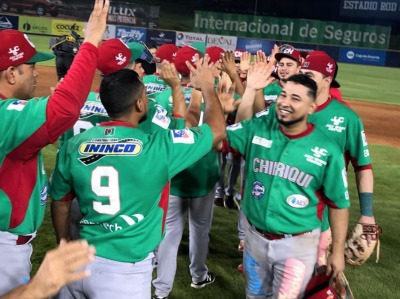
Its happening April 27-29, 2018
Sadly, our team Chiriqui Occidental (of Puerto Armuelles) didn't make into the final series, but Chiriqui (of David) did.
Chiriqui is battling it out with Bocas Del Toro. The team who wins 4 out of 7 games is crowned champion.
After 4 games it was 2 and 2! But in the end, Chiriqui lost the championship to Bocas del Toro.
Chiriqui really wants to win this championship. They were the champions in 2016.
Then Colon beat Chiriqui to win last year's championship. But I must say Colon deserved the win. It was the first time in 54 years that Colon won the championship.
Regardless, Chiriqui wanted the title of champion back in 2018.
Chiricanos (people from Chiriqui) are very proud of their province. And they have many reasons to be proud. One being baseball.
Chiricanos are very very good at baseball. You won't make any friends rooting for a rival team.
Carlos Ruiz - Major Leaguer
In fact, one of David's prodigal sons, Carlos Ruiz, played in these 75th Championship games. Ruiz is a catcher in US Major League Baseball. He started with the Phillies, then went to play for the Dodgers, then the Mariners, and is now a free agent.
Ruiz is the only player in the history of the National League to catch four no-hitters, and 1 of only 2 catchers in Major League Baseball, the other being Jason Varitek. (source: Wikipedia).
Baseball in Panama has two leagues, Juvenile League and the Panamanian Major League (AKA Panama Baseball League).
Each of Panama's 10 provinces has its own Juvenile and Major League baseball teams. However, Chiriqui is so good at baseball it can field 2 teams: Chiriqui Occidental (Puerto Armuelles) and Chiriqui Oeste (David).
Not even the Panama province has 2 baseball teams and it is hands down the most populous province in the country. (FYI- The province of Panama's team is called Panama Metro.)
In the Major League, the Panama Metro team wins many championships, Herrera is often a contender, and Chirqui continues to hold its own.
The 11 teams are: Bocas de Toro, Chiriqui, Chiriqui Occidente, Colon, Cocle, Darién, Herrera, Los Santos, Panama Metro, Panama West, and Veraguas.
Well, actually, 22 teams if you count both the Juvenile and Major league teams. And they both should be counted. Panama takes its juvenile league very seriously.
TIP: One quick way to start a friendship with a local Chiricano is to ask about their baseball team.
As it turns out, baseball was not introduced to Panama by the Americans who came to build the canal. It started well before then. Baseball has been played in Panama as far back as 1883 when Panama was still a province of Colombia.
On Jan. 9, 1883, Panama’s Daily Star and Herald described a baseball game played in Chiriqui Plaza 2 days before. It was between a team from Chiriqui Province and members of the Panama Cricket and Baseball Club. (See Chiricanos have had a very long love affair with baseball). The Cricket and Baseball Club won. That team was mostly made up of West Indian workers brought in during the failed French-managed canal construction.
However, Panama's baseball history may go back even further. Back to a time before Amerca had even standardized rules for baseball. In his book, Historia del Béisbol Panameño, the Panamanian historian Ramon G. Pérez Medina writes that the 1st baseball game was played in Panama in the mid-1850s. One team was made up of American traders and the other team was men affiliated with the Panama Railroad Company.
In 1945, the Panamanian Major League was created. As I mentioned, the league has 11 teams: Bocas del Toro, Chiriqui, Chiriqui Occidente, Colon, Cocle, Darién, Herrera, Los Santos, Panama Metro, Panama West, and Veraguas
The first Panamanian to join an American Major League Baseball team was pitcher Humberto Robinson, who debuted with the Milwaukee Braves on April 20, 1955. Including the 4 major leaguers who were born in the Canal Zone, Panama has sent more than 50 players to the U.S. majors. That total includes recent players: Ruben Tejada, Christian Betancourt, Randall Delgado, and Carlos Ruiz.
Find out about the 10 Best Panamanian Players in MLB History, here.
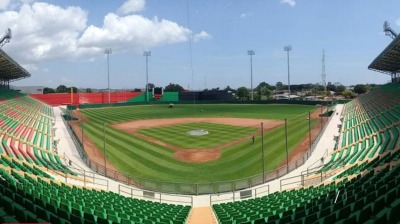
The Kenny Serracin Stadium in David, Panama is brand new.
It had its first game on March 23, 2018. And Chiriqui won!
(David is the capital of the Chiriqui Province)
Chiriqui was playing against one of their top rivals Herrera. Huge celebrations ensued!
The stadium has seats for 8500 fans. The old stadium only accommodated 2000 people.
It is all tricked out with lights and modern boxes. It was built to comply with the requirements of a Major League stadium in the States.
Where is it?
It is easy to find. It is pretty big.
It is by the intersection of the Interamericana and the overpass of the new road to Boquete. Another way to think about it, is that it is close to the Super Baru, the supermarket. Or better yet, punch the address into WAZE.
The Address
Calle P Norte (e / Av. Obaldía and Vía Belisario Porras)
David ,Chiriquí
About Kenny Serracin - the Man
Kenny Serracin is from Puerto Armuelles! (which is where we live in Panama). That is where he learned to play baseball. He also worked picking bananas in the banana plantations near Puerto Armuelles. Mr. Serracin later moved to David, where taught PE at a school in Doleguita. He then worked as the administrator and sports director of the original baseball stadium.
All the while he continued to play baseball. He was playing for Chiriqui when it won its first championship in 1944.
He was a man who worked for the love of the game.
In the 1970s, after he stopped playing ball, Mr. Serracin worked with the Lions Club to form little leagues teams and he helped to reorganize baseball throughout the province.
[leadplayer_vid id="5ACF9FB62ADFA"]
You may have heard that our beach town, Puerto Armuelles, Panama has some big news.
After many, many years of complete neglect, our airport is being entirely renovated.
And officials have even told us that there will be domestic commercial flights flying in and out of Puerto.
This is Betsy of Living in Panama. The place for information and advice on being an expat in Panama. Interested? Click subscribe and hit the bell, so you don't miss a video.
Recently, Puerto’s Mayor explained we will have a new runway, all new buildings, and a much better security fence. But better than the one you see here.
And let me tell you, there is nothing like taking a video to get all the officials in charge to come talk with you, which is what happened to me.
While we talked, these government officials told me, that 1 year from now Air Panama will offer flights into and out of Puerto Armuelles from Panama City, David & Bocas.
The officials seemed very certain that Air Panama would offer flights into and out of Puerto. Only time will tell if it really happens, but it seems possible. The President of Panama has already visited Puerto 3 or 4 times about the airport renovation.
Sadly, the airport renovation does mean that the community will lose a much valued exercise and open space. Right now, most evenings and early mornings, you will find many people on the airport runway and surrounding fields. They walk, run, play soccer.
You will also see horses on the airport a lot. Even in this photo, you are seeing horses, even while demolition is underway.
And it looks like, I didn’t actually check, but it looks like they have already demolished the airport’s 9 hole golf course.
It was pretty incredible that there was a golf course at the airport.
I'm really hoping that the renovation moves as fast as the officials I talked with anticipate. And, I have to say, that so far, at least during this demolition stage, the work seems to making rapid progress.
The airport is good news, both for the economy and for convenient travel. And once there are commercial flights here it will be much easier and faster to get to and from Puerto Armuelles.
Currently, the fastest way to get to Puerto is to fly into David, which is a little more than an hour drive away. And get
then get transportation from there.
If you haven’t heard of Puerto Armuelles yet, it is a charming beach town on the Pacific Ocean in the Chiriqui Province of Panama. Chiquita Banana built this unique and historic town starting in the 1920s.
For more information about Puerto Armuelles, click here.
You can explore our beautiful beach property for sale, by clicking here.
And again, this is Betsy Czark of LivinginPanama.com. Thanks for watching
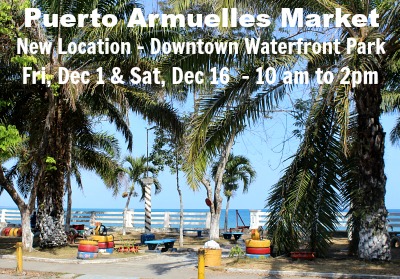
The location is now in a more central spot.
It will be at the downtown waterfront park.
The park is located between the bus station and the pier.
The market no longer occurs on the 1st Saturday of the month.
Now it is coordinated with the typical twice monthly payday (on the 15th and 30th).
There will be 2 markets in December
Most everyone seems to agree that the 8am start time is just too damn early.
Now the Market will be held from 10am - 2pm.
Most likely, the dates and time will continue to be tweaked. So check back toward the end of December.
The market will continue to solicit donations for Los Animales of Puerto Armuelles.
There will be a donation can at each vendor's table.
Please give generously.
Learn more about Los Animales of Puerto Armuelles.
Buy and/or sell items at the market.
You can buy or sell plants, fruit, handicrafts, used and new items, and much more.
If you are selling, don't forget to bring your own table.
Watch a video of the 1st Puerto Armuelles Market here.
The legislature had already given their full approval in September by passing Bill 509 after 3 debates.
The new property tax rates are effective January 1, 2019.
There are now new and higher exemptions from property taxes
This means that if you buy your primary home in Panama for under $120,000, you will not owe any property taxes. Starting January 1, 2019, your property would be fully exempt.
Currently, Panama’s property tax is a graduated tax. I believe that is not changing.
If so, when you purchase a $200,000 house you would only pay property tax on $80,000 of its value. (ie., $200,000 minus $120,000 exemption = $80,000 of taxable value.)
As you will see in the tax rates below, that means you would pay a 0.5% property tax rate on this $80,000 of value. Which means, you would only owe $400 a year in property taxes. Wow.
This is a substantial reduction in property taxes in Panama.
Currently, only the 1st $30,000 of property value is exempt from property taxes.
Since the majority of property in Panama is valued under $120,000, this means that most property in Panama will be exempt from property taxes.
You can read about the current (through 2018) property tax rates in Panama in this post.
The reform bill also offers an amnesty program for those who currently have unpaid property taxes.
My understanding is that if you pay your taxes by December 31, 2017, all fines and interest will be waived. Any unpaid tax through August 31, 2017 is eligible for the amnesty program.
I am not positive about the details of this amnesty program. If you know more, please share in the comment section below.
Keep in mind, if you own titled property, you owe taxes.
You will never get a bill for your taxes. It is up to you to remember to pay them - and on time! If you don't pay them, the government will take their cut (tax + interest + fees) when you sell your property.
Primary Residence
$0 - $120,000 = Exempt
$120,001 - $700,000 = 0.5% tax
$700,000+ = 0.7% tax
Secondary Residence, Commercial Properties, Industrial properties
$0 - $30,000 = Exempt
$30,001 - $250,000 = 0.6% tax
$250,001 - $500,000 = 0.8% tax
$500,000+ = 1.0% tax
Currently, the Panama government is spending alot of time and energy encouraging people to title their property. For many reasons, the government wants to improve its real estate transaction systems. A first step is getting land titled.
Most land in Panama is not titled. And most people are happy with owning Right of Possession (ROP) or untitled land. One reason for this is that once land is titled, it will be taxed.
For this reason, it is hard to convince people to title their land.
They have never paid property taxes, and never expected to do so. And really, who wants to pay taxes? Plus many property owners cannot afford to pay property taxes, of any amount.
The solution: Exempt most property owners from property taxes.
Since most land in Panama is valued at under $120,000, the government decided to make that the exemption threshold.
This rationale for the property tax reform is complete and total conjecture on my part. I have not read anything to support my supposition, but it seems right to me.
What do you think? Please share your thoughts in the comments below.
In September, IPAT opened up an office of Tourism in Puerto Armuelles. The new tourism office is located in the Super Yen mini mall, which is across the street from San Antonio Catholic Church and school in downtown Puerto Armuelles.
With the opening of the first IPAT offices here in Puerto Armuelles, the Tourism Ministry obviously wants to make itself more accessible to tourists in Puerto Armuelles. This is excellent news for Puerto.
Any government program to promote Puerto Armuelles is welcome. For years, the town has been sort of the “Cinderella” step-child of Panama—a secret beauty who has been kept hidden in a dark corner of the kitchen.
The Tourism Ministry says that it is stepping up efforts to promote tourism in order to create jobs for Panamanians in Puerto Armuelles.
Their technique, in the short term at least, is to invite local business owners to set up tables at the next Puerto Armuelles fair. The ideas is that these business owners will advertise and sell directly to the public.
They have encouraged all interested parties to reach out to folks in other parts of Panama, particularly in Chiriqui, to connect with the already developed tourist areas such as Boquete and Volcan.
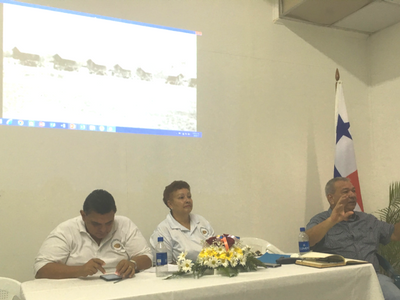
On a Wednesday afternoon in September, the Panamanian Ministry of Tourism (IPAT) hosted a meeting of local hotel and restaurant owners, and anyone else interested in talking about how to promote tourism here in Puerto Armuelles.
It is a wonderful coincidence that this meeting took place the same week that Heavenly’s Hotel was sold to a group of hoteliers/tourism promoters from Boquete.
I went to the meeting. There were perhaps 25 of us at the meeting, half from IPAT, and half local business owners.
The 2nd meeting of the group was at the fair grounds, where participating businesses have been asked to come and decide where they would like to put their display booths, any new ideas, etc. (I did not attend that meeting since we don't plan on having a booth.)
In total, there are to be 3 of these planning meetings to gather ideas from local businesses and open up an ongoing dialogue.
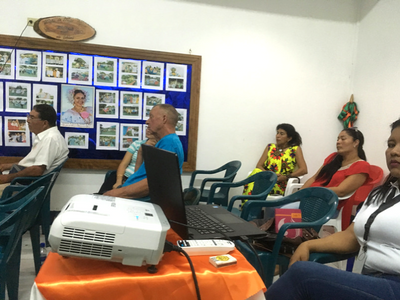
There were 2 local expat businesses present at the 1st meeting, including myself. We each had the same suggestion.
We need an ongoing campaign to encourage Portenos to stop being such “litter bugs”.
In short, litter hurts tourism.
This message was recognized by the committee, and was talked about at length.
Coincidentally, I had just gone to the local radio station, Radio Mi Preferida, earlier that same day to discuss the same issue, litter. I asked the station to donate air time as part of a campaign to educate local people about the negative economic and environmental impact of littering.
Fortunately, the owner of the radio station, Professor Mora, was also at the tourism meeting that afternoon.
Professor Mora heard the plea for a new no-littering radio campaign. If I don’t get a chance to see him this afternoon, I will stop by the radio station within the next week or so and see how he plans to help out.
Litter is a problem all over Panama; not just in Puerto Armuelles.
It is easy to keep it under control on the beaches, just with a few minutes a day of “litter patrolling” by local hotels and home owners with beach property.
However, if we want to get at the root of the problem, we have to start with education. It is hard to get anyone to change their old habits. I think a educational radio campaign is the ideal place to start. Most locals listen to Radio Mi Preferida on a daily basis. And often for most of the day.
To be honest, I missed the 1st hour of the meeting on Wednesday. I was attending the regular Wednesday expat social hour at the new Big Daddy’s Beach Resort and Hotel. So I am not sure if there had been any talk about Internet advertising of tourism in Puerto.
For those of you reading this this online post, you are probably aware that the Internet is an excellent way to communicate quickly to an audience. However, as with government programs in any country (think the US Postal Service), change in Panama is slow.
My guess is that it will take some time before tourism here in Puerto Armuelles is extensively promoted online by the government.
At this time, Puerto Armuelles is not even mentioned on the Panama's tourism website: visitpanama.com. Of course, Boquete, Volcan, and Pedasi are not mentioned on Panama's Tourism website either. Although, their site does include information on Bocas del Tour, Panama City, and other places.
The good news is that we are here to pass the word along for them!
If we can assist the Ministry of Tourism to help get Puerto Armuelles “rockin” again, we are all in!
(I am sure that this is the unanimous feeling among all local business owners.)
Thanks for reading,
Reyn