This property is located in the Corazon de Jesus neighborhood of Puerto Armuelles.
Hi, this is Betsy Czark from Living in Panama.
And this is a glimpse of the beach that's in front of this property we have for sale.
This gorgeous property is big:
- 11,000 sq. feet
- Only 70 yards from the beach
- Located in Puerto armuelles,
To get to the charming beach town of Puerto Armuelles,
- Take a short flight from Panama City to David, which is in the Chiriqui Province.
- Then drive an hour and 15 minutes to historic Puerto Armuelles.
What you see here is Puerto Armuelles’ downtown waterfront park.
Puerto was built by Chiquita Banana starting in the 1920s.
Chiquita built a town with a charming look and feel and one that looks different from most other towns in Panama.
Puerto is also unique in that it is one of the only ocean-front towns in Panama.
Up ahead you can see a row of restaurants and bars facing the waterfront park, as well as a statue of the town’s namesake, Colonel Armuelles
On the left, you can catch a glimpse of it’s popular “town square” park, plus a new playground.
Right now, let’s go to 11,000 sq foot property we have for sale.
This beautiful property is only 10 minutes from downtown Puerto Armuelles.
We are almost at the property now. All the beachfront homes, which are to your right on this street are owned by expats.
The property is in a great location.
Not only is it close to downtown, but there are restaurants, grocery store, and a hardware store even closer - 5 minutes away.
This beach neighborhood is a mixture of locals and expats.
The cement building on the corner has now been remodeled to be a garage for the expat who owns the beachfront house across the street.
This is the ample 16 foot wide access road to the property.
Welcome to the property!
This sizable property is both beautiful and quite affordable.As you can see, since I am easily driving on it, this property is flat and ready for your home construction.
Actually, this property could fit 2 or 3 houses on it.
The property is serviced by city electricity and water.
Currently, this neighborhood is not on the city sewer, but our new mayor has vowed to change that. In the meantime, like many beach communities, septic tanks are used.
And as I mentioned, this property is quite affordable.
This 11,000 sq foot property is only $40,500. Plus we offer easy financing.
As we exit the property, you will see how close the beach is.
You can easily stroll on the beach, swim, stand up paddle board, or surf from your property.
It is a wonderful place to live.
I leave you with some views of the beach.
For more information or to tour the property, contact me at LivinginPanama.com by clicking the link.
Living in Panama: The place for information & advice on being an expat in Panama.
Interested? Click "subscribe" and hit the bell so you so you don't miss a video.
Thanks for watching!
Normally, my items would have been bagged in plastic in a blink of an eye.
That morning the cashier just let them sit on the counter.
Suddenly remembering the new rule, I grabbed my few items and left.
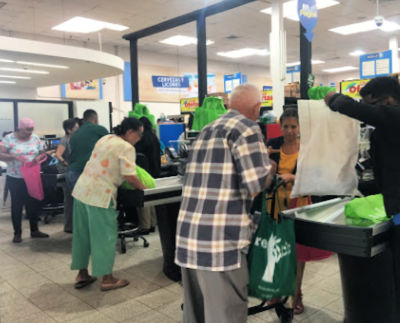
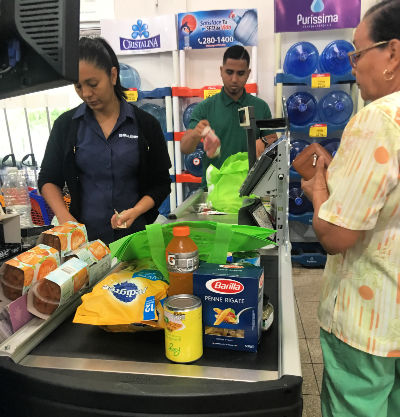
Later that same day, I shopped at our Romero (a national chain of grocery stores.) Walking around the store I was surprised at how many people had remembered to bring reusable bags from home. One woman was even filling her's up as she shopped.
Noticing that, I went to my car and grabbed my bags. (Luckily my husband had thought ahead and stashed some there.)
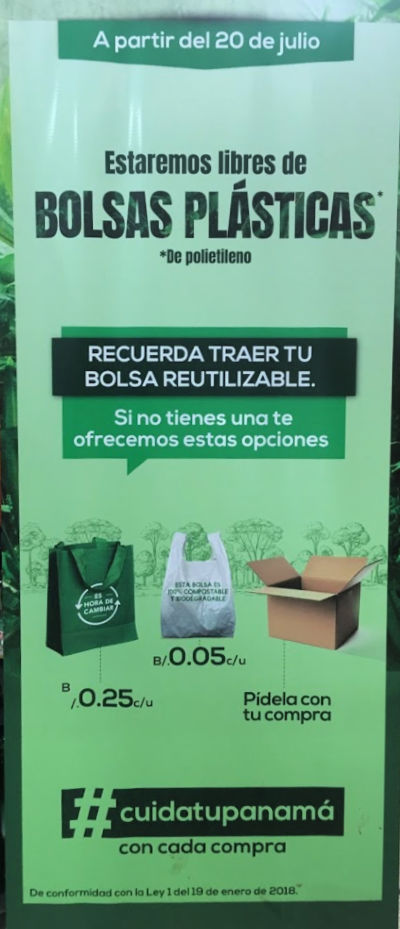
When I returned to Romero a couple of days later, they had displays explaining your bag options (see photo).
So no worries, if you forget to bring your own grocery bags you have options. At least at Romero's.
At Romero, if you forget your bag, you have 3 options:
Before the law went into effect, Romero was selling an assortment of reusable bags. My favorite has a watermelon design. I bought 2. I think they are $2 each. Romero still sells the "watermelon" bags, but not in the checkout area.
I went to a few other stores to find out about their bag situation.
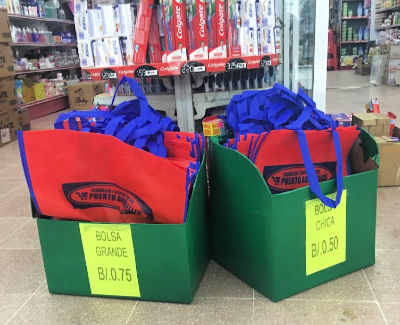
Supermercado Puerto Armuelles. On July 25th, I went back to Supermercado Puerto Armuelles, our mid-size and popular grocery store. It was now offering 2 sizes of their branded disposable bags for 50 and 75 cents, depending upon size. (see photo).
Super Centro Baru, a nearby and smaller grocery store, also offers Supermercado Puerto Armuelles bags for sale and at the same price. That is the only bag option Super Centro Baru offers.
According to the cashier, the 2 stores are not owned by the same people, they are associates.
Disney. I also visited nearby Disney, one of Puerto's long-time grocery stores. Disney offers zero bag options. The women in line with me had brought one of Romero's green-colored reusable bags with her.
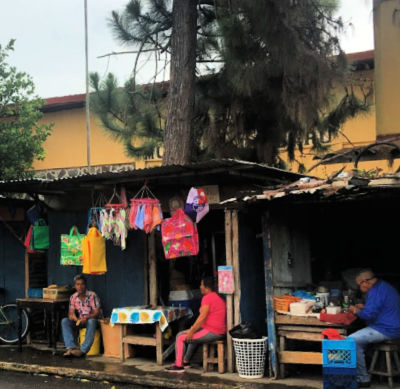
However, if you forget to bring your bag to Disney, you can buy one at the stall across the street from it. The stall offers bags ranging from $1 to $3 (see photo).
Produce stands still seem to use plastic bags (see photos), but seemingly not the type that are banned.
FYI: The new law did not ban all plastic bags, just single-use polyethylene plastic bags. Polyethylene is what those ubiquitous “T-shirt” plastic bags that most grocery stores use are made from.
The clear bags I see produce stands using are made of polypropylene. You can tell because polypropylene bags are clear, polyethylene bags are translucent.
Given how they are everywhere, it seems incredible that those T-shirt plastic bags were only invented in the early 60's.
I bought fruit and veggies on July 20th, and it was put in a large plastic mesh bag. Most likely due to the size and weight of cantaloupe and watermelon I purchased.
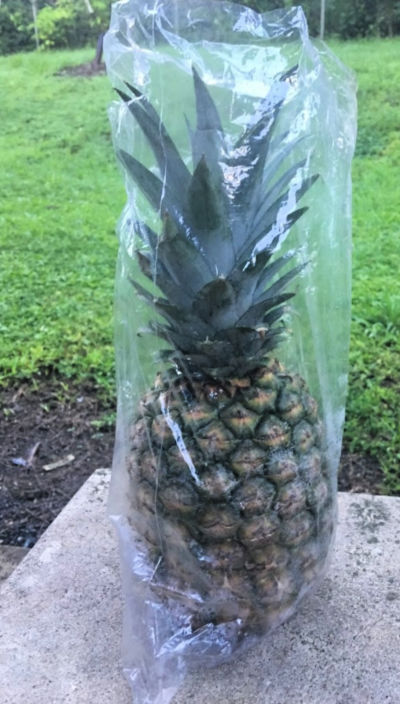
A few days later I bought a pineapple from the same stand. They put it in a clear plastic bag. (see photo)
They bagged my pineapple immediately, without asking. I definitely did not need a bag for my solitary pineapple.
A gentleman who was buying some veggies at the same time had brought his own small reusable bag. However, the vendors still put his veggies in a clear plastic bag and then put that bag into the reusable bag he had brought with him. As I mentioned, I believe these clear plastic bags are not banned by the law.
Perhaps over time, the automatic action of bagging produce in plastic will diminish as vendors get used to people bringing their own bags.
It seems that the people and government of Panama are increasing embracing environmentalism.
Perhaps the effect of the new plastic bag law will far exceed its goal of reducing plastic consumption by 20% across Panama.
My daughters explain how to preserve your bananas and more in the video above.
Betsy: Welcome to the 2nd video in our "Fruit in Our Yard" series.
By the way, our yard is in the charming beach town of Puerto Armuelles, Panama.
We are producing these videos in alphabetic order.
Join us as my daughters show you the Bananas In Our Yard.
[I'm Betsy from Living in Panama, the place for information and advice on being an expat in Panama. Interested? Click subscribe, and hit the bell. So you don't miss a video.]
Skylar: These are the bananas in our yard. They're a little past their prime on the tree.
We've been picking them slowly.
Normally, if you wanted to preserve the entire bunch and ripen them at your leisure, you would chop it here and hang it from a sort of a rafter or any high place you have. Then put a bag around it to protect it from the birds that might want to get at it before you.
Blaise: And what you can also do is, you can leave actually them on the tree and get some mesh bags to cover it.
And as you can see, some ripen at different times.
These are very small, just starting. These are green and these towards the top get more sun and are ripe. Like here, they are ready on this side.
Skylar: Yes. These here have been all picked and some of them have been eaten by birds.
Blaise: Like these and that.
Skylar: This is what happens when you don't preserve the bunch. So if you wanted to preserve it, as we said, you put a mesh bag around, either on the tree, or take it off and hang it somewhere for it to ripen.
[Note: you can use plastic or any other opaque bag to cover ripening bananas in order to keep birds from eating them.]
They usually ripen better off the tree actually.
Blaise: And we can show you one is still green. It has not been covered, over in our front yard.
Skylar: Okay, so this is across the yard from the earlier bananas that we showed you. But these are not quite ready to be picked or even for the birds to want them.
It's quite a beautiful bunch, honestly.
Blaise: As you can see, up there, it is starting to ripen a little bit on the higher branches.
Betsy: Where? Oh, yeah.
Blaise: You can see a little yellow. And so that is normally the time you should probably start bagging.
Actually, if you remove some of the leaves above it, it can help it as well.
Betsy: Help it what?
Skylar: Ripen more quickly of course.
Blaise: And grow.
Skylar: Yeah.
Blaise: And in the next video we'll probably be showing you how to use bananas and plantains in dishes.
Skylar: Yes, how to cook your bananas or plantains - for beginners.
Skylar & Blaise: Bye. Thank you for watching. Subscribe. And like. And share with anyone who might be interested. And click the notification bell. Have fun.
Betsy: Please click the link below for more information about Puerto Armuelles. Thanks for watching.
Our next "Fruit In Our Yard" video will feature the cashew tree.
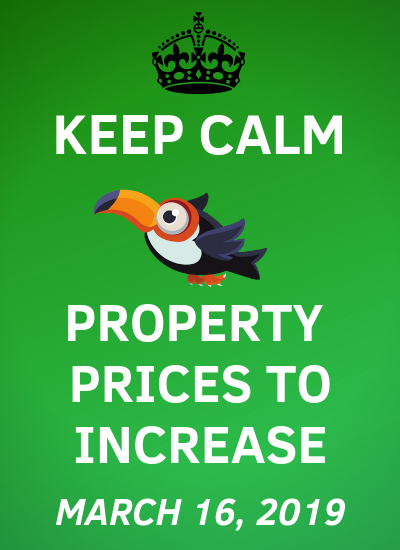
We are raising our property prices on March 16, 2019.
On average, our property prices will increase by 10%.
NOTE: Back in November, we posted about a property price increase to occur on January 15th.
However, we did not announce the January 15th price increase to our Newsletter subscribers until January 1st.
In response to our Newsletter subscribers, we have delayed the increase until March 16th.
Even with the price increase, we will continue to offer beautiful, high-quality properties - at some of the lowest prices around.
1. - For over a decade, property prices all over Panama have been going up.
Meanwhile, Puerto Armuelles, hidden away in the Northwest corner of Panama, has not seen those same price increases.
Puerto Armuelles is now hitting its stride to catch up with the rest of Panama. Consequently, real estate prices in Puerto are starting to go up.
2. - Property Upgrades. For over a decade, we have continued to make improvements to our properties. This means that we can offer you the best planned, best maintained, most attractive, properties in Puerto.
3. - Rising Costs. The cost of various types of permits, infrastructure, and maintenance has been going up.
4. - Buzz about Puerto Armuelles. For the past 2 decades, ever since Chiquita Banana pulled out, Puerto has been generally ignored. No longer. There has been a noticeable uptick of new people, esp. foreigners, spotted in Puerto Armuelles. This spike in interest goes beyond just visitors and retirees. There is also a significant push by Panamanians to develop more space for shops, restaurants, and offices.
5. - Puerto is getting more services. Renovations of existing services, as well as the construction of new public services, are at an all-time high in Puerto Armuelles. 4 significant civic projects are currently underway. (see below)
6. Arrival of Del Monte. Since Del Monte Foods arrived in Puerto Armuelles, about a year ago, there has been a big uptick in interest in our town, both by investors and prospective retirees.
Del Monte is a sign of better economic times to come. Not only will Del Monte's banana operations provide significant annual revenue to the city, but they will be cutting regular paychecks for many residents.
7. Return on investment looks very good. The Republic of Panama continues to attract investments from all over the world, particularly from China. More and more of that money is showing up in Puerto Armuelles.
It is clear that Puerto's dark ages, after the departure of Chiquita Banana, are in the past, and the "Puerto Armuelles' Renaissance" is moving forward full speed ahead.
We will make no official predictions, however, it would not surprise us if Puerto Armuelles provided retirees, investors, and 2nd home buyers with the biggest returns in all of Panama. Time will tell.
Have you been thinking about buying a property from us? Then take another hard look in the next 2 months, before the price increase - or before your lot is sold to someone else. Our real estate price increases go into effect on March 16, 2019.
If you have questions, please feel free to contact us.
Have you visited Puerto yet? Why not buy a ticket and come on down this year? Let us know you are coming and we will give you a tour.
You will never know if Puerto is right for you until you visit.
Do you currently have a property on Reserve? Or are you making payments on a property? In either case, these price changes obviously do not apply to you. However, they do indicate that you can easily sell your property for more than you paid for it.
Reserve one of our properties before March 16th, you will freeze the current price for 60 days.
Anyone else who wants to buy a property after March 16th, will have to pay more.
It is fast, easy, and inexpensive to reserve your property.
The reservation fee is only $1000, and it is credited toward the property purchase. The 60-day price freeze starts the day the hold fee is received.
Learn more about reserving a property here.
2018 has been a big year for Puerto Armuelles. And 2019 promises to be even bigger.
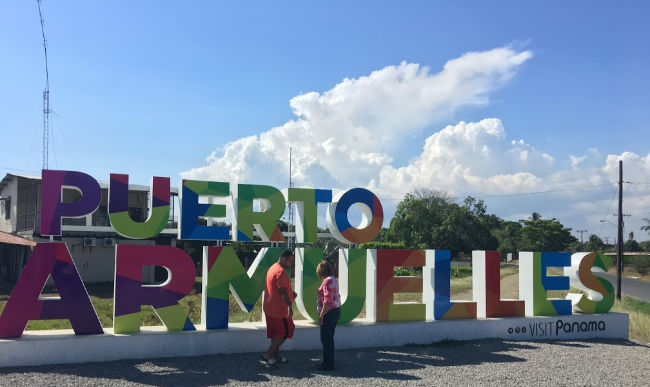
Colorful town signs have been popping up all over Panama.
After much anticipation, Puerto Armuelles has one of its own! (see photo above)
Our beach town is coming up in the world!
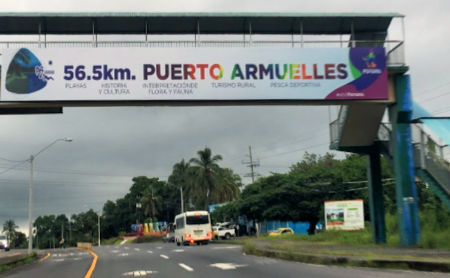
Panama's national tourism agency, Visit Panama, is promoting Puerto elsewhere too.
I was able to photograph its banner promoting Puerto Armuelles (see photo).
The banner was hanging on an overpass outside of David, on the way to Puerto Armuelles.
It is not at the roundabout.
Many people assumed that the Puerto Armuelles sign would be installed on our new roundabout.
The roundabout, the only one in Puerto, is near the entrance to town. It was installed as one of the final parts of the road expansion from a 2 lane to a 4 lane road.
It seemed like this wide round expanse of lawn was custom-made to celebrate our town's sign.
Safety Issues Determined Location
But the design aesthetics of putting it on the roundabout lost out to safety concerns.
Not only would the two-word high sign hamper visibility, but that location would put pedestrians in harm's way.
There is no parking nor sidewalk at that location. People would have to cross the circle road, on foot, to take a photo of themselves by the sign. It is not a busy road, but there is enough traffic to make that potentially dangerous.
In fact, the sign was up for only a few hours and people were already climbing all over it to take town-proud photographs.
We are very much looking forward to taking a group picture by the sign ourselves.
I have been impatiently waiting for Puerto Armuelles to get its own colorful 3-D sign for quite some time now. I am quite happy that we finally have it.
Sign Location
The sign is located on the main road - past the roundabout - as you head into town.
More specifically, it is in the Los Angeles neighborhood, between Restaurante Enrique and ESPA.
There is plenty of space for pedestrians and cars to hang out by the sign. No need to endanger yourself by dashing across the street to take a photo.
Feel free to post your photos of the sign in the comments below.
So instead of one long video, we are making 13 short ones.
We are producing the videos in them in alphabetical order, as follows.
(1) Almonds, 2) Bananas, 3) Cashews, 4) Coconuts, 5) Crioyos (native orange) 6) Eucalyptus (rainbow type - yes, not a fruit, but its leaves are useful), 7) Lemons, 8) Mangos, 9) Maracuya (Passion Fruit), 10) Nance, 11) Papaya, 12) Pineapple, and 13) Plantains. There are many more fruits in Panama, but these are the ones that grow in our yard, or right across the street.
In this 1st video, we celebrate the tropical almond.
Transcription of the video appears further down the page.
True Almond trees do not grow in the tropics. Panama's almond tree (Terminalia catappa) is not related to the true almond tree. True almond trees are the ones that produce the almonds we buy at the store.
The tropical almond tree got its name because its seed pods look like large unshelled almonds plus its seeds/kernels resemble almonds. It also goes by many other names: sea-almond, Indian-almond, false-almond, country-almond, and many more.
However, unlike true almonds, the outside of the fruit is also edible. Plus you don't have to cook the seed to eat it. Both the seeds and the fruit of the tropical almond are edible in the uncooked, raw state,
The tropical almond tree grows by the ocean. The tree can grow in sandy soil and is mildly salt tolerant.
This large, fast-growing tree can reach, on average, 30-55 feet tall. It has large bright green leaves that turn red before falling off. The tree also produces many small, white flowers which develop into fruits. The flower's scent is barely noticeable.
The tree will produce fruit and nuts within 3-5 years. Seasonally, you can harvest up to 11 pounds of nuts (shelled) from a tree.
It is a messy tree. Leaves, fruit, and kernels litter the ground underneath it. This can be a problem because the fruit contains high amounts of tannic acid so it will stain any paving, maybe even your car, if they are under the tree too.
Interestingly, the tree does not attract much wildlife. Some tropical ants like it. Fruit bats eat the husk. And bees are attracted to the blossom, but apparently, have a difficult time making honey from them.
It's all edible. (If you know the movie Rocky Balboa, you may recognize that line.)
The fruit has a pleasant aroma, but is not especially tasty, although it is edible. The fruit ripens from green to yellow to red and has very little pulp, but a very large seed kernel. The husk is corky, thin with green flesh inside.

The ripe husks of the fruit can be eaten raw and are best when young and sweet. Although when the fruit is ripe can vary.
The seeds have an almond or hazelnut flavor.
The waterproof nature of the tree’s wood makes its lumber ideal for canoes.
The leaves and bark are sometimes put in fish tanks to increase water acidity and reduce bacterial infections amongst the tank’s inhabitants.
Medicinally, the tree has had a myriad of uses in folk medicine for everything from sickle cell disorders, leprosy, nausea, diarrhea, and as a contraceptive.
However, there is research that suggests it might be useful in treating high blood pressure. Also, leaf extracts have some anti-diabetic and antioxidant properties.
There is much more fruit in Panama than the 13 we are covering in our "Fruit In Our Yard" video series. But only those 13 fruits grow in our yard.
The following Panama fruit do not grow in our yard (although most of them do grow in our neighborhood): Avocados, Breadfruit, Cacao, Grapefruit, Guanábana, Noni, Mangosteens, Momo chinos, Tamarindo, and more.
Up Next: Bananas. Check out the banana video here.
Betsy: Welcome to the first of our series: Fruit in Our Yard.
We're doing it alphabetically.
We're starting with almonds going through coconuts, lemons, nance, papayas, pineapple, and ending at plantains, and lots and between.
Right today, we're starting with Almonds.
Subscribe Plug: Its Betsy of living in Panama, the place for information and advice on being an expat in Panama. Interested? Click subscribe and hit the bell so you don't miss a video.
Skylar: Okay. So this may be cheating a little. It's a little out of our yard.
Betsy: It's across the street.
Skylar: It's across the street, but I think it's very interesting. This is an almond tree.
Blaise: It looks basically like a cashew tree, actually.
Skylar: I didn't know where almonds grew before I came to Panama. But given that I was five, it wasn't that unimpressive.
But yeah. So actually, here is one right now.
Blaise: They grow in little pods.
Blaise & Skylar: They look like this. This is a very under-ripe one.
The ripe ones are fuller and more spotted. Ripe ones are larger, yellower, more even, and they have some brown speckling. And as can see here, this has none. Maybe this one, this has one speckle, but it would be all over it and all these ridges would fill out.
But inside here. It's a little meaty on the inside. Then you have the seed, which is the almond.
Betsy: You should know that with the tropical Almond, both the seed pod and the seed are edible, without any cooking. Although it's quite the endeavor, especially to get the seed out, as the girls mention
Skylar & Blaise: It's pretty straightforward. Although, it might be a little more effort than it's worth than buying a bag. You should just buy 'em. Buy em.
The modern world is wonderful. Don't need these [raw seed pods] anymore. It's just a great tree though.
As you see...
Betsy: Join us next time as we explore the bananas in our yard.
Skylar & Blaise: Thanks for watching. Be sure to like comment, share, subscribe, and click the bell icon if you want notifications.
Betsy: For more information about tropical almonds and life in Panama. Click the link below. See you there.
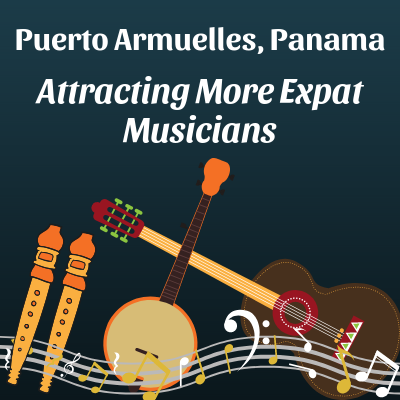
Over the past several years, I have noticed a steady stream of expat musicians arriving in Puerto Armuelles. I am not exaggerating when I say that I have met at least 6 new expat musicians who have moved here in the past year or two. No doubt there are others whom I have not met.
One expat musician, as you will see below, is offering to teach adults the recorder.
In the Corazon de Jesus neighborhood, there are 2 really good guitar players who live side-by-side in remodeled Panamanian concrete block houses. This is of particular interest to me since I have taken up the guitar as my “old guy hobby”.
Just this past week, I spoke on the phone with a couple who are curious about venues for performing their music in Puerto. They will be visiting Puerto for the first time soon.
So far, we have not had any sort of “open mic” nights in Puerto like the ones in Volcan or Boquete. However, with the arrival of so many musicians here perhaps a regular open mic event could be organized.
I know that Heavenly’s Hotel (Now Big Daddy’s) did have a few musical performances by local expat musicians. However, such events were not regularly scheduled. I will talk to Dave, one of the owners of Big Daddy’s Hotel, to see if anyone has expressed interest in performing lately. Hopefully, Big Daddy’s would welcome such a regular event. Come to think of it, Dave plays the drums. He doesn’t perform, but he loves music.
In Puerto’s Coronado neighborhood there is a family of musicians, Melinda, Ingrid, and Melinda’s son Ramy. They all play guitar. However, Melinda’s passion is the banjo. Not surprisingly, Melinda, in particular, is very enthusiastic and knowledgeable about bluegrass music.
Some very good news is that Ingrid is offering recorder lessons for interested adults. She is a retired music teacher from Anchorage, Alaska. As I mentioned above, Ingrid also plays guitar.
The recorder is a great instrument for learning the basics of music. And you can take it as far as you want to go. Ingrid has brought a number of alto recorders with her to Puerto so that she can assist those who want to give it a try.
(FYI, a basic recorder is easily purchased in Panama since the recorder is taught to most students sometime during elementary school.)
With luck, maybe she can even get a little recorder ensemble together. That sounds like fun.
If you are interested in lessons, contact Ingrid Lindberg of Puerto Armuelles via Facebook.
I'd be interested in taking up the recorder again. Many years ago, my brother and sister-in-law, both musicians, gave our family an assortment of recorders. We brought them down to Puerto over a decade ago, hoping we would starting playing the recorder. But it never really interested our kids nor my wife. (I had played a recorder for a couple of years as a child. I can’t have forgotten it all, I hope.).
I am going to dig through our various boxes of “stuff” and find those recorders. Then, I am going to get in touch with Ingrid to start re-learning the recorder. My attitude is that it is never too late to start to play music.
If you are a musician, or if you are interested in getting started playing music, please let us know. We'd be happy to steer you to others in Puerto who share your passion.
Thanks for reading, Reyn
Interested in Creating Art?
Check out more happiness-enhancing hobby suggestions
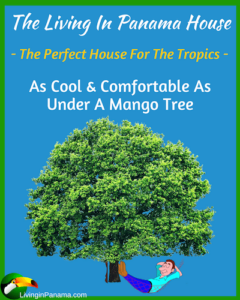
The Living In Panama House is, in essence, is a big covered porch, wrapped around the bedrooms and the bathrooms. Compare this with a more typical construction of a house with a porch attached.
Depending upon the model you choose, up to 75% of the house is an open-air secured and covered porch.
Our design gives you the same cool feeling as being in the shade under a big mango tree by the beach.
You’re protected from the sun, and there is nothing between you and the refreshing breeze.
Being under a big shady Mango tree at the beach is as cool as it gets here. That is, unless you turn on the air conditioning.
We are positive about this.
There is a big beautiful mango tree on lot 6 of our Corazon de Oro property, where we check the temperature throughout the day. It is the coolest spot around.
Made in the Shade of A Mango Tree
Why is it so cool and comfortable under a big shade tree with a cool breeze blowing?
This seems like a silly question. We all know it’s true.
However, when designing the perfect tropical house, you must ask, “Why is it true?"
1st - Mature Mango trees provide a wide area of dense shade.
The dense shade of the Mango tree protects you from the sun. Not only that, it also shades the ground all around you. This means that the entire area under the tree does not heat up, allowing you to stay cool and comfortable.
2nd - Mango tree branches are high up, so they don't block the ocean breezes.
Because it can easily flow under the Mango tree, the breeze is free to work its evaporative magic upon your skin, keeping you cool.
And, don’t forget about the psychological effect of air movement. Air flowing over our skin, makes us feel cooler, even if the temperature hasn’t changed. This phenomenon is known as the “perceived” cooling effect.
What else can we learn from the Mango tree, so we can build a really great tropical house?
Actually, that’s it. The secret to building a cool tropical house, believe it or not, is not to ruin this simple formula: Provide deep shade and don't obstruct the cooling breeze -- Shade, air movement, evaporation, and perceived cooling.
Most builders botch tropical houses because they build the way they always have. They don't stop to think about context, about what produces a comfortable house in the tropics.
Expats' Thoughts On Their North American Style Homes
From various studies and surveys, and through our own observations, we have learned a lot about expats who live in North American style homes in Panama.
How does the Living in Panama House bring together all the elements necessary to imitate the cool, comfort beneath our big mango tree? Shade, air movement, evaporation, perceived cooling.
The mango tree has these going for it. What about the Living in Panama House?
1st, the Living in Panama House has wide, 5-foot roof overhangs. This means that, just as if you were relaxing in a hammock beneath our big mango tree, you are protected from the sun by this big, sheltering roof. It also means that no part of the Living In Panama House, except the roof, is exposed to sunlight. By keeping the house structure from heating up during the day, you don’t heat up. What’s more, you will stay cool and comfortable all night.
Now, back to our mango tree comparison: The leaves at the top of the Mango tree get very hot, during the day, due to direct contact with the sun’s rays. Since a mango tree has so many layers of leaves, all that heat is trapped; It never gets to you, napping in your hammock down in the shade.
In the case of the Living in Panama House, we actually have the mango tree beat here. The mango’s tree’s thick canopy requires tons of branches and leaves to provide shade down below. Obviously, this is not a good model for building a house; It’s an inefficient use of materials), By contrast, The Living In Panama House has a metal roof, and galvanized steel roof framing.
Metal roofing is the most popular roofing in Panama, so it is readily available.
2nd, our metal roof system is very lightweight, or low in mass, which means that the roof can’t store heat.
3rd, the roof has a dramatically energy-efficient roof color, white. A white roof can reduce surface temperatures by as much as 100 degrees Fahrenheit, compared to a dark roof color. This means those solar rays are reflected right back into space. This is known as the Albedo Effect. The end result: a significantly cooler house. To learn more about why a white roof is the best choice for a cooler house, check out this article on the Texas Smart Roof, here.
4th, the metal roof is strong. It does not rest on top of the walls the way it does in typical house construction. Instead, the Living in Panama House roof is connected to the walls by a series of steel columns. The steel column supports are welded to steel reinforcement poured integrally into the concrete walls. This is the strongest roof design we have seen here.
Our Living In Panama House roof system is special in another way too.
5th, there is ample ventilation space to allow heat to escape and daylight to enter. In our current model home, there is 132 lineal feet of open ventilation between the roof and the top of the walls. At 2.5 feet in height, this ventilation system provides 330 square feet of ventilation, high up where you want it. (By comparison, a big 3’x 5’ double-hung window offers about 9 square feet of ventilation). This is just one of our vent systems.
What’s more, this high vent is not only a perfect way for the house to expel heat, but it is also the ideal location for clerestory lighting. This design, allowing natural daylight to enter the house high up, completely eliminates the dark, cave-like feeling that is found in many expat homes in the tropics.
Our tropical sun here is extremely bright. Without the extra effort to balance the lighting, the contrast between the blinding tropical sunshine and the relative dimness of the indoors gives an impression of gloominess. The interior daylight of most houses here makes you feel a bit as if you were in a basement apartment in the States. I like spaces that are light and cheery, so I find the interior light of theses homes depressing.
6th, There is no space where the heat will get trapped. Beneath the Mango tree, there are no walls (no doors, nor windows either). Nowhere for heat to get trapped. The Living In Panama House is similar, in that there is almost no floor to ceiling walls except in the bathrooms and bedrooms. (However, the bedrooms and bathrooms also have tall windows and doors for light and ventilation). The breeze can circulate freely throughout all of the living spaces, constantly exchanging the interior air for clean, fresh air right off the ocean.
7th, Long and lean design to allow free airflow. Another advantage to our design is that the Living In Panama House is long and lean, so the breeze can easily pass through the entire house.
Wide, fat houses are a mistake here in the tropics. That style of house requires more walls, plus interior hallways to access the spaces deep inside the house.
8th, Gable roof acts as a chimney to release any heat build up. The gable roof of The Living In Panama House is perfect for cross ventilation. Both ends are open. The peak of this beautiful roof is way up there, nearly 19 feet off the ground. There are no drop ceilings (unless you add them). This means there is a vaulted ceiling sloping upward from 13 to 19 feet overhead. We all know that heat rises. Since heat is free to migrate naturally upward and then be whisked away by the breeze, The House stays cooler. You stay cooler.
I have always loved the look of the old Chiquita Banana houses with their half-hipped roofs. You have probably seen them on our website, or maybe you’ve already visited Puerto Armuelles and seen them there. These roofs are a classic. They are part of the historic look of Puerto Armuelles.
When we first arrived in Puerto, I thought I'd like to copy the look of the Chiquita era homes, including the half hip roofs, but with a few design tricks to make them more efficient. To be honest, it took me a few years to finally accept the reality that hip roofs are beautiful and historic, but they don’t work.
Hip roofs, even half hip roofs trap heat. Even when they have those charming little wooden vents on the half gable ends In fact, the attic of our own Chiquita Banana House heats up to over 150 degrees on summer days. Finally, I had to let go of my love affair with the Chiquita Banana half-hipped roof.
9th, the Living in Panama house is designed for big ceiling fans for those days when the wind doesn’t want to blow. Ceiling fans are an attractive and efficient way to move warm air up and out of the house. They are a classic, tropical look that dates back over a hundred years.
10th, the Living in Panama house is A/C ready too. Obviously, not everyone wants to live without air conditioning. Some days, you just feel like going indoors and sitting in the media room, or the office, or taking a nap in a truly “chill” space. For that reason, the bedrooms, office/media room, and the bathroom zones are all designed for air conditioning. The decision to create an air-conditioned “cool zone” is up to you. These zones can be as big, or as small as you wish.
11th, easy to enclose more space over time. With our Living In Panama House design, it’s simple to enclose more space. You could even enclose it all if you really want to A/C the entire house. However, we suggest that you live in your new house for a while to experience what combination of fan vs A/C fits your tropical lifestyle. Then, with our system, it is very easy and fast to add walls, windows, etc, if you decide to adjust the Living In Panama House to your needs.
We think you will enjoy living in a Living in Panama House. If a Living In Panama House fits your needs, please let us know.
We will send you its construction plans. They cost $250 if you are not buying one of our properties. The plans are free if you do buy a property from us.
Don't forget, if you buy one of our properties, we are here to help answer your questions about the LIP House all along the way.
If you have questions, please feel free to contact us.
Explore Corazon de Oro: The most beautiful beach properties in Puerto Armuelles.
We updated & expanded our Places to Eat page to include:
Click to see this expanded Puerto Armuelles restaurant info.
Discover information on more of Puerto Armuelles neighborhoods:
You can now find info on all these neighborhoods:
Plus there are more photos.
I will be adding more photos over the next few weeks too.
To see this expanded neighborhood info, click here.
We hope you find this expanded info helpful.