I had never even considered it as an option. Moving to Panama changed that.
Many expat families in Panama homeschool. Some of those, like me, had had no plan to homeschool before moving to Panama.
Deciding to homeschool can be scary. It feels like a lot to be responsible for your kid's education on top of everything else. I have since become pretty passionate about the benefits of homeschooling, but acknowledge it is not the right choice for everyone.
For a long time, I have wanted to share what I have learned about homeschooling in Panama. However, to be honest, I have been too busy with life and homeschooling our 2 daughters to tackle this large and complex topic.
2 recent events have prodded me to finally share my homeschooling experience and knowledge
As I look at all my notes for this article, I can already see that this topic will be better broken up into several articles. I will cover many topics in those homeschool articles, such as:
I will just start with the most obvious one: Why homeschool in Panama.
I am not going to go into all the reasons to homeschool wherever you are in the world, not just in Panama. Although, I will share a TED Talk video below which I find conveys a very compelling pro-homeschool argument, no matter where you live.
[leadplayer_vid id="5BB17319133C3"]
In this post, I focus on how the education offered in Panama is a reason to homeschool.
Many expats, and increasingly locals (esp. in Panama City) decide to homeschool because most schools in Panama are terrible.
Not all schools, but most.
At that 1st ever homeschooling conference, I asked a Panamanian mother who has lived in Massachusetts and Panama City about schools in Panama. I specifically asked whether she thought the expensive private school in Panama City were good schools. She replies that she was not impressed with the expensive private schools in Panama City. She homeschools.
However, I think these private schools are still a far superior option than other available local schools. Unfortunately, these schools very expensive and there are only available in a few areas in Panama. Most of them are located in Panama City, although there is one in David, One in Boquete and a few others elsewhere in Panama. A Google search will uncover many of them for you.
Panama's Almost-Last Place In Global Ranking
It is not just my opinion about schools in Panama. The last time Panama permitted its students to take the PISA test and get ranked against other students in the world, the results were dismal. The PISA test is taken by 15 years olds in countries around the world to assess their skills and knowledge. The intent is to help lower-income countries improve their educational system.
In 2009, Panama education was ranked 3rd from the bottom in the world. The only countries that ranked lower than Panama were Peru, Azerbaijan, and Kyrgyzstan. "The knowledge of a 15-year-old student in Panama is equivalent to that of a 12-year-old student in other OECD countries. Panama has a three-year delay in schooling," said Sebastián Grandchild.
(OECD stands for Organization for Economic Co-operation and Development, which is the parent organization for PISA. Check out this PISA link).
Since it's embarrassing 2009 ranking, Panama refused to be part of PISA test in 2012 and 2015.
Hope for the Future? New Rankings Soon
However, the new head of Education in Panama welcomed the testing this year (2018). The results are not in yet.
Importantly, Panama also participated in PISA's capacity needs analysis. The 2018 conclusion is that MEDUCA (Panama's education department) is severely lacking in staff, esp. staff trained in assessment. In addition, they found that Panama has no effective school assessment plan or tool. On the plus side, PISA says that Panama has the resources and the apparent will to create one and to improve its schools.
Crossing my fingers. Because, although there is a lot of government talk about the need to improve schools in Panama, not much has changed in the classroom. There has been a push & funds for more technology in the classroom. But the curriculum remains humanities-centric vs STEM-based, and there is a lot of pushback from the unions about changing the system. And of course, Panama's oligarchy-leaning system is not over-eager to better educate it's poor.
One reason Panama's schools are so bad is the typical teaching methods. Many schools emphasize rote memorization.
Also, teachers tend to value their students repeating the correct answer over developing problem-solving skills or deepening their understanding of a topic.
To give an example, schools are required to teach at least one class in English. I have had kids, one who is in a supposed English immersion school, read to me from their English books. They did great, although with some pronunciation issues. But when I asked them, what they read they could not tell me. They could read in English, but they did not understand it. Maybe they teach English comprehensive later, but I have been surprised by the lack of understanding from elementary school children.
Also, an amazing amount of classroom time is spent on copying. First, the student watches their teacher write a lesson on the blackboard. Then the child will spend even more time copying what the teacher wrote down into one of the many single subject notebooks they are required to use.
My younger daughter particularly hated the copying. She simply could not keep up with the kids who have been copying - and only cursive is allowed - for years. Plus she didn't even understand what she was copying down.
The same is typically done for homework assignments. Instead of distributing printouts of lessons or homework, the children have to copy them down. And they are graded on their penmanship - all in cursive. This doesn't leave a lot of time covering material or for questions. In fact, in our experience in Panama's schools asking too many questions is not encouraged.
Plus, there is an inordinate amount of busywork for homework. Cutting, pasting, and coloring feature strongly in the homework of elementary students. They even sell books to use to easily accomplish the required cutting and pasting homework. Before I discovered those books, I spent much time looking the required image in magazines or online to print so my daughter could accomplish her mindless homework assignment.
If you send your children to school, they can still learn and keep their love of learning alive. But it will take some participation by you. Perhaps they need some supplemental learning opportunities, or simply an open, "we love learning" attitude expressed at home to counteract the dullness they may experience at school. Thankfully, Panama's school typical schedule of ~7 am to 1 pm, this makes it easier to find time to do any needed supplemental learning.
Going to school in Panama does have strong advantages for expat kids, which I explore in a future article.
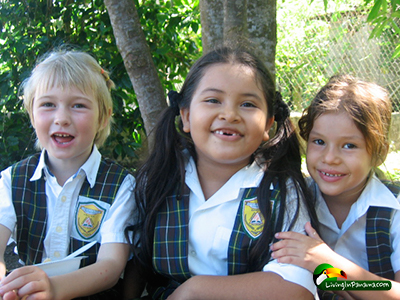
Although, the longest that I ever attended one of these schools was four months. This is because the style of teaching is so different from what it is in the US.
In the schools here, the teacher has the only text book in the class. So a lot of the time spent in class is occupied with either copying your down your lessons off the white board, or
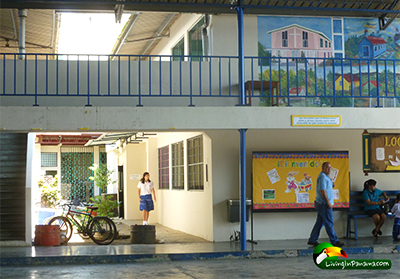
copying down your homework. For some reason the school system seems allergic to printing out worksheets.
I've heard from several of my friends that still attend school here, that they only go to school to see their friends. The quality of learning leaves much to be desired, and the curriculum is mediocre at best.
The students learn math and history and the other essentials, but the there seems to be no emphasis on reading or continuing your education beyond high school.
There are good things too, for example in some schools you can play a variety of sports and can learn many of the traditional dances. All the schools have a marching band, and they all participate in a yearly city parades.
If you're looking into schools here there are a few things you might want to know.
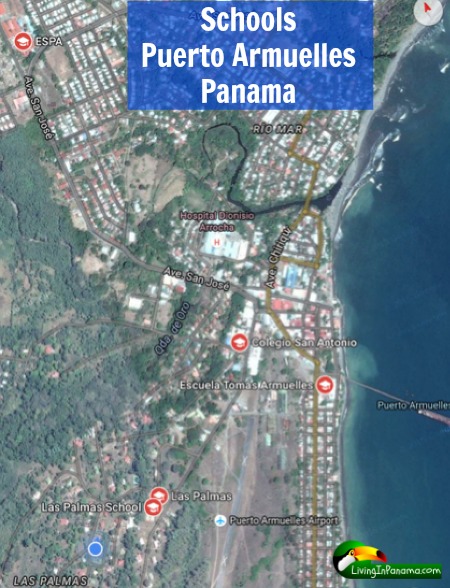
First, of all the schools here Escuela Secondario de Puerto Armuelles (ESPA) is the largest and most highly recommended in town. From what I've heard it also has the highest standard for learning. It is also the only one with a band with instruments, other than the drum and xylophone.
You may also want to read a post I (Betsy) wrote about schools in Panama. It includes a short video of my daughter Skylar in her 1st grade class here in Panama.
Among the other schools here, the one I attended most recently was San Antonio. San Antonio is known as one of the higher profile schools in town. This school is a three in one: elementary, middle, and high school, all in one large building. It has kept up a reputation as a fairly good school for the last 50 years. However it's elementary school is known to be poorer quality then some of the others in town. The middle school is supposed to be one of the best. San Antonio was the school that made me
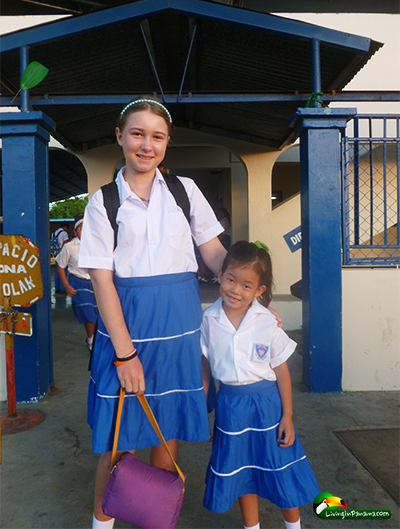
decide that the Panamanian school system was not for me.
The last school on this short list is the Las Palmas school, which is located, of course, in the Las Palmas neighborhood. This is the school I have attended most frequently, three times to be exact.
My take-away from the Las Palmas School is that it is highly over-estimated. A couple of decades ago, at the end of the Chiquita years, the Las Palmas school was the best in town. And now over twenty years later people still believe it to be one of the best schools.
However the truth is that with the contribution of bad principals and teachers, the school has deteriorated. This school is supposedly bilingual, but from my experience the school's English teachers speak worse English then an American five year old. That may be a bit harsh, but it's the truth.
The students I've met that have attended the Las Palmas school can barely string together a sentence in English.
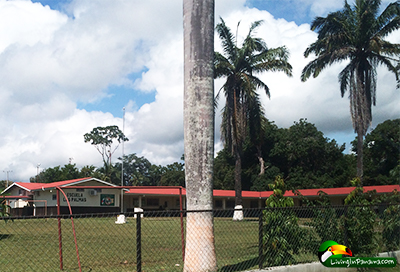
Oh fun fact before I go, the original Las Palmas school building was burnt to the ground, maybe in hopes of erasing it from the school system. But is was rebuilt, and sadly still features ever the decreasing teaching and learning standards taught there.
This is, of course, only a brief summery of the most popular schools here in Puerto.
I have provided a list of all schools in Puerto Armuelles at the end of the article, as well as
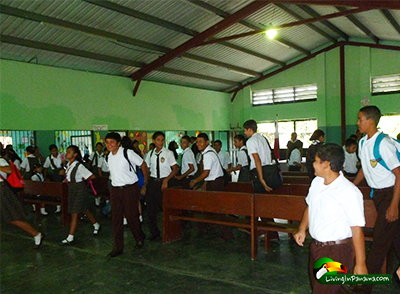
their geographical locations.
If you can't find one of the schools on the map you may have to ask around town.
If you would like more information about a particular school ask me in the comments.
Thanks for reading.
Skylar.
This article was written by my 14 year old daughter, Skylar Vayda. Over the winter, Skylar will be writing a Panama-related articles. She will be picking the topic. We hope you enjoy them.
P.S. School starts here in just a few days -Monday, Feb. 29, 2016.