April 26, 2017
This is excellent news for the economy of Puerto Armuelles and its district of Baru.
It will also be good for many folks in Bocas del Toro.
Which is why all the Chiricanos and Bocatoreños deputies in the Legislature voted yes on it.
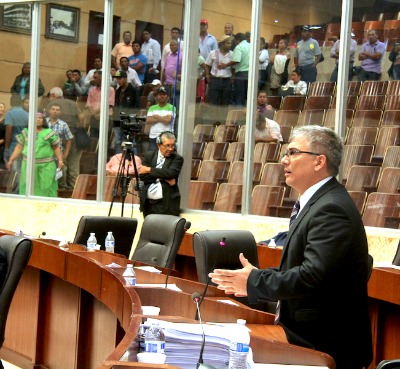
Our very own Porteño, deputy Carlos Motta (see photo) of the Democratic Revolutionary Party (PRD), was a major proponent for this bill. I hear he is very happy that jobs and more bananas are coming to Baru.
(Note: Baru is a district in the Chiriqui Province. Puerto Armuelles is the principal town in Baru)
More Jobs
Jobs are why locals were so eager for Del Monte to get the final go ahead by the National Assembly.
More Bananas
The agreement requires that Del Monte put 900 hectares into banana production each year. (Note: the banana fincas are mostly located in the hills above Puerto Armuelles.)
On average, a hectare of land produces 2,725 boxes of bananas a year.
This means alot more bananas. Maybe we will finally be able to find bananas for sale in Puerto Armuelles on a regular basis.
The Details
The Contract between the State and Banapiña details a "Banana Reactivation Project".
It includes:
The contract is for 20 years, and automatically extendable for another 20. However, its tax exemptions must be reviewed by the state after the initial 20 year term.
The 5804 hectares that Del Monte will lease include 4030 State-owned hectares and 1,774 hectares owned by individual owners (including Coosemupar) who will lease them to the State. The State in turn will sublease those 1774 hectares to Del Monte (aka Banapiña). There may be an option for Del Monte to buy those 1774 hectares in the future.
The land must be leased since 90% of the banana plantations are less than 10 kilometers from the border. Foreigners (like Del Monte) are forbidden by the Panamanian constitution to own titled land within 10 kilometers of the border.
Until very recently, there have been continual delays in Del Monte getting permission to grow bananas in Baru.
The Government has made promises & then broken them.
Some progress was made.
But then it was stuck.
The "by early 2017" promised deadline had come and gone.
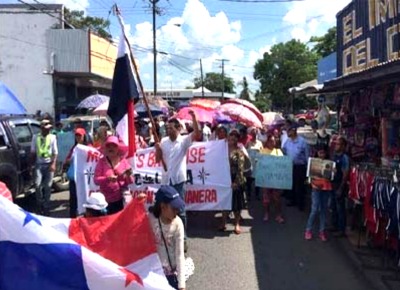
In March & April 2017, Portaneos took to the streets over the delay.
They organized marches and other peaceful protests to put pressure on the government. They wanted the deal approved by the legislature so that Banapiña Panama, a subsidiary of Del Monte, could finally produce bananas in Puerto Armuelles and other parts of Baru.
The protests seems to have worked.
FYI - they voted yes on Bill 488, the contract between the State & Banapiña Panama to reactivate banana production in Baru
It is now fully approved!
Del Monte (Banapiña) can now start to grow and harvest bananas in Puerto's banana plantations and in other areas of Baru.
The negotiations have involved many factors and obstacles.
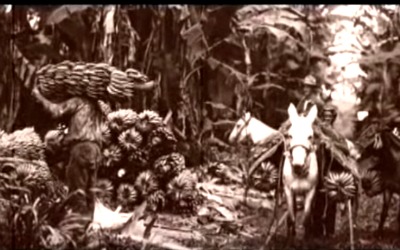
Puerto Armuelles was once synonymous with bananas. Starting in 1928, Puerto was built as company town. And it’s company was Chiquita Banana. Unfortunately, racism by the company and worker unrest lead to its workers striking and sabotaging Chiquita Banana’s crops.
Finally, in 2003, Chiquita sold its now unprofitable Puerto Armuelles banana business to a local cooperative, called Coosemupar. Due to a number of factors, Coosemupar was not successful, although it still limps along in a very limited fashion.
Chiquita's departure had a dramatic impact on Puerto Armuelles' prosperity and population. The town went from having close to 50,000 people to alittle more than 20,000 in 2010. The government has not done a census since 2010. But anecdotally, Puerto's population is more than 25,000 these days. Because even without a banana company, Puerto Armuelles's economy has been steadily improving over the last 5 years.
Adding Del Monte to Puerto Armuelles' economy will be a tremendous boost to its prosperity. Both Puerto and Del Monte have been counting on this. Del Monte has been in Puerto for awhile now getting things into place so they would be able to start work once they got the okay from the National Assembly.
It will be exciting to see what happens once the green gold of bananas is seen in the streets of Puerto Armuelles once again.
You can learn more about Puerto Armuelles by starting here.
Interested in living in our charming beach town? Check out our Puerto Armuelles real estate.
To learn more about the backstory of Del Monte coming to town on my site, read about the Minister of the Presidency, Alvaro Aleman, visit to Puerto Armuelles in July 2016. President Varela also touched on the status of Del Monte on his visit to Puerto in September 2016.
January 19, 2012
Economic Freedom Feels GoodPuerto Armuelles has been in economic shackles for years because of the enormous debt owed by Coosemupar.
Coosemupar is a worker cooperative that owns and operates the many banana plantations in the Puerto Armuelles area of Panama.
President Martinelli and members of Coosemupar, signed an agreement that states that the government will:
This is great news for those of us living in Panama, especially in Puerto Armuelles.
Until the early 2000s, Puerto Armuelles was a prosperous and beautiful beach town.
Then Chiquita Banana left.
Chiquita Banana has had a tremendous impact on the physical look and the economy of Puerto Armuelles; for good and for bad.
Chiquita came to town in 1927. It was called United Fruit Company back then.
Chiquita transformed Puerto Armuelles into a unique jewel of a town.
Chiquita built whole neighborhoods of great classic wooden tropical houses on stills, a club house, golf course, and an airport.
Most importantly, Chiquita Banana provided a steady supply of relatively high paid work.
Starting in 2003, when Chiquita Banana left Puerto Armuelles, the town's economy has diminished steadily.
At that time, Chiquita's banana plantations were taken over by a workers' cooperative named COOSEMUPAR.
1) A self-serving (now former) union leadership that treated the cooperative as its own personal property. It was the antics of this same union that prompted Chiquita to leave Puerto Armuelles. It wasn't the only reason, but the union's penchant for debilitating worker strikes was a significant reason for Chiquita's departure from Puerto.
2) Chiquita Banana imposed the biggest obstacle to Coosemupar's success.
As part of the terms for the transfer of operations to Coosemupar, Chiquita required that the bananas from its former plantations be sold exclusively to Chiquita. Not only that, but Chiquita got to decide what to pay for those bananas. Perhaps in revenge for forcing them to leave Puerto, Chiquita set the price they would pay for Coosemupar's bananas way below the market price.
These 2 factors guaranteed the ultimate failure of the cooperative.
The only reason that Coosemupar survived was due to government subsidies.
Unfortunately, given Coosemupar's self-serving leadership, those subsidies were not always used appropriately.
After years of these subsidies, the Panamanian government finally insisted that Chiquita renounce its exclusive banana contract with Coosemupar. Chiquita eventually complied.
Unfortunately, by that time, Coosemupar was a crippled company with massive debt.
No one would buy and take over operations from Coosempar because of its debt.
A new company would have to pay the almost 20 million dollar debt.
In addition the plantation workers were still living on the plantations. Those workers want to be compensated for all their time and efforts in keeping the banana trees alive - usually without pay.
In addition, most prospective buyers wanted the workers removed from the plantations. This was not popular with workers who had lived there for years, sometimes for generations.
Various companies started negotiations to buy the banana plantations from Coosemupar, but they always backed out.
However, soon that will be all behind Puerto Armuelles.
The Ministry of Economy and Finance (MEF) will sell by public auction the 3,500 hectares of plantation land. MEF will award the land to those companies that will generate the greatest number of jobs.
Using the proceeds from the sale of the plantations, the government will pay the debt own to Social Security for the worker-employer portion of the retirement funds.
In addition, the workers will receive individual titled land upon which to live. This process of awarding land to plantation workers will take 6 months to a year to complete.
This agreement is a great relief to the people of Puerto Armuelles.
A vision for Puerto Armuelles's future is slowly and steadily being implemented.
A construction project to widen the 2 lane to a 4 lane road to Puerto Armuelles will begin soon.
The key reason for the road project is to service the deep container port outside of Puerto Armuelles. Construction of this pier is estimated to begin in conjunction with the road construction project . The future Puerto Armuelles' port will have 217 storage facilities, a deepwater container and future cruise ship port, and a marina.
The Puerto Armuelles road is envisioned as a 4 lane "dry canal" highway connecting Puerto Armulles to Chiriqui Grand on the Caribbean side of Panama. It is anticipated it will have a similar economic effect to the "wet canal" in Panama City
These 2 construction projects along with the government's agreement to cancel the debt of Coosemupar and the workers, shows that the Panama government is through ignoring the once-vibrant town of Puerto Armuelles. The Panama government is now activity promoting the economic revitalization of Puerto Armuelles.